Style Philosophy
There is a prevailing attitude today that to be avant-garde, one has to produce clothing that is ugly, shockingly sexual or otherwise uncomfortable to look at. Beauty is now relative, a standard that is always being redefined. Creating classically beautiful garments is regarded in some circles as quaint and old-fashioned. I disagree.
I maintain that the truly revolutionary stance in today’s climate is to produce clothing that is beautiful and beautifully made, enhances one’s appearance, and is both a joy to look at and a pleasure to wear. By combining 21st-century materials with traditional techniques, I create garments that clearly express this distinct vision of beauty.
Having lived in San Francisco has inspired my work. I have been deeply influenced by the Beaux Arts architecture of its civic buildings, a style that harkens from the Belle Epoque period in France. This pre-World War I period was a time when people enjoyed splendor in their daily lives. This attitude lies at the very heart of my designs.
The Belle Epoque saw the work of Mariano Fortuny, whose design aesthetic and fashion philosophy mirrors my own. Both artist and designer, Fortuny produced beautiful garments in an immediately recognizable style. Where many designers try to reinvent themselves twice a year, Fortuny adhered to a classical aesthetic that reflected few of the vagaries of fashion. His pieces could be worn and enjoyed by the original purchaser throughout her entire life.
I take Mariano Fortuny as a model for my creativity and business. I prefer to work at a more human pace, to be evolutionary rather than revolutionary. My work functions outside of fashion, in that realm where timeless style dwells. Thus, my garments remain beautiful and viable, bringing pleasure to the wearer over a long period of time.
The events and special occasions associated with that particular garment add to the piece, and each wearing carries this pleasant history forward. Consequently, my work is painstakingly constructed to withstand years of wear and is conceived with the wearer in mind. Each piece is designed and built to perform as conceived, so it can be worn with ease.
Aside from expressing aesthetic influences, my pieces also answer a design question for me. These explorations usually involve a technical or engineering challenge that I’ve set for myself. To successfully meet my aesthetic concerns, the solution must have a construction so seamless, so carefully worked as to be utterly invisible. When the process is successful, the design transcends the process.
Modern fabric and construction technology make my proprietary construction techniques possible. Though my aesthetics arise from the Belle Epoque, the garments themselves are truly twenty-first-century inventions. As such, old-world beauty is translated into a garment that is easily worn in the modern world.
History
Flawless engineering and construction has always influenced King’s design aesthetic. The engineering challenges involved in making a particular effect appear spontaneous have always fascinated him.
When developing this new body of work, King has worked with an eye towards creating designs that, though not mass-produced, could be made in limited editions.
King’s move to New York matched his desire to form new techniques and designs, to make a complete departure from what he had done in the past. Most of his previous work involved many layers of fabric and innovative engineering to get certain effects. By choosing a transparent fabric, he had to create garments in which the construction, now completely on view, was as attractive as the design.
The research to develop this body of work took nearly three years of making what Kenneth calls “lab notes”. This rigorous, evolving series of samples and notes finally yielded the techniques he sought. They also offer a rich library of ideas to draw from. The permutations are almost endless and will keep his work fresh for years to come. This work satisfies Kenneth’s desire to create proprietary techniques and designs. In the long view, his goal is to be the 21st Century’s answer to Mariano Fortuny.
King decided to focus more on private clients. A chance remark from one of his favorite clients turned him in a new direction. “One spends all this money on the dress,” she asked, “what does one wear over it?” King had experimented with wraps in the past, but this client helped him understand uses and types of wrap needed for the spectrum of events his customers attend. This started him on a new direction technically as well as aesthetically. King’s relationship with Maxfield had lasted nine years. During and beyond that time his designs were carried at Wilkes Bashford, San Francisco, and Ultimo in San Francisco, Dallas, and Chicago.
During the time King spent selling to private clients and boutiques, his work and reputation grew with museum curators and private collectors. His work is in the permanent collections of London’s Victoria and Albert Museum, the L.A. County Museum of Art, San Francisco’s DeYoung Museum, as well as many private collections.
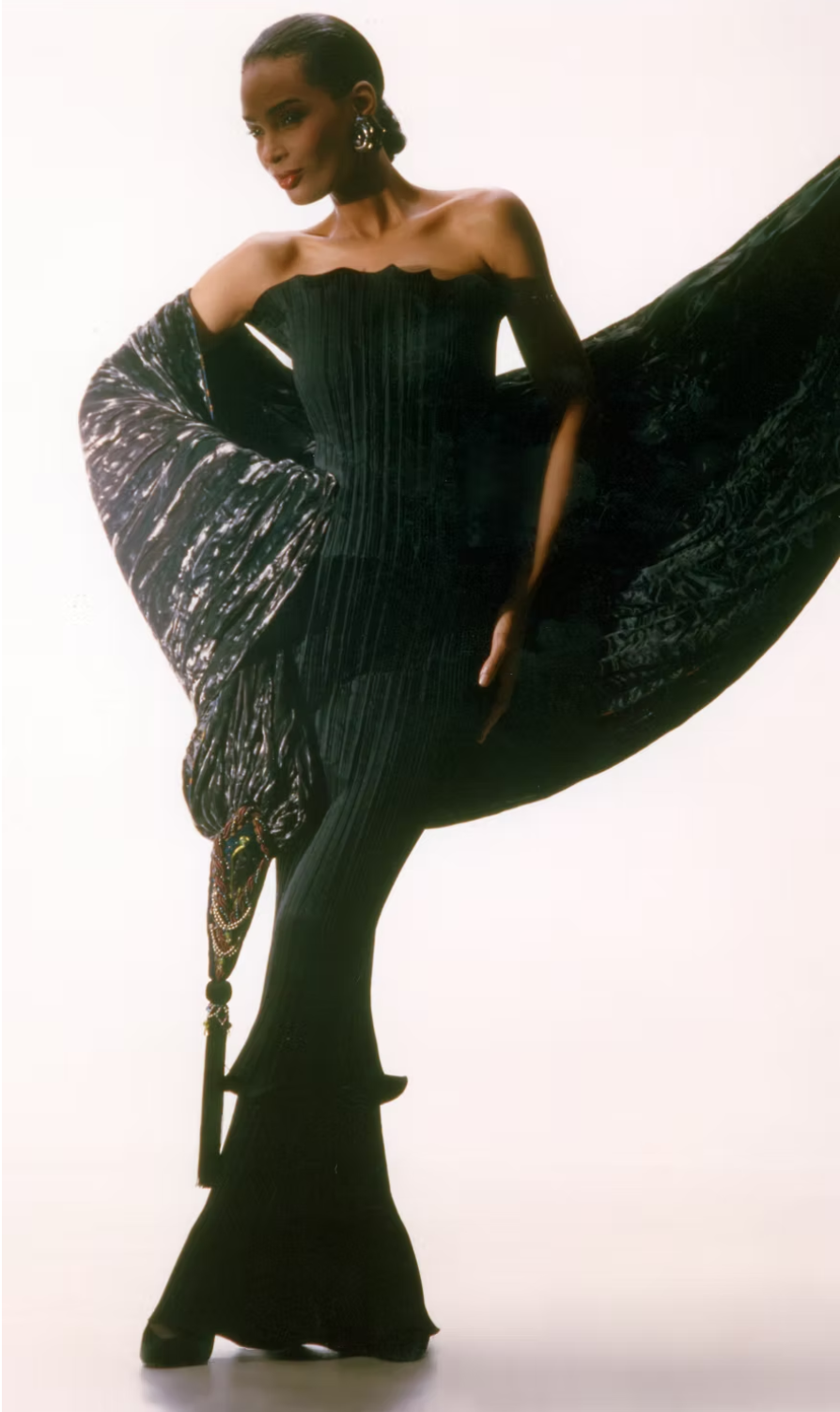
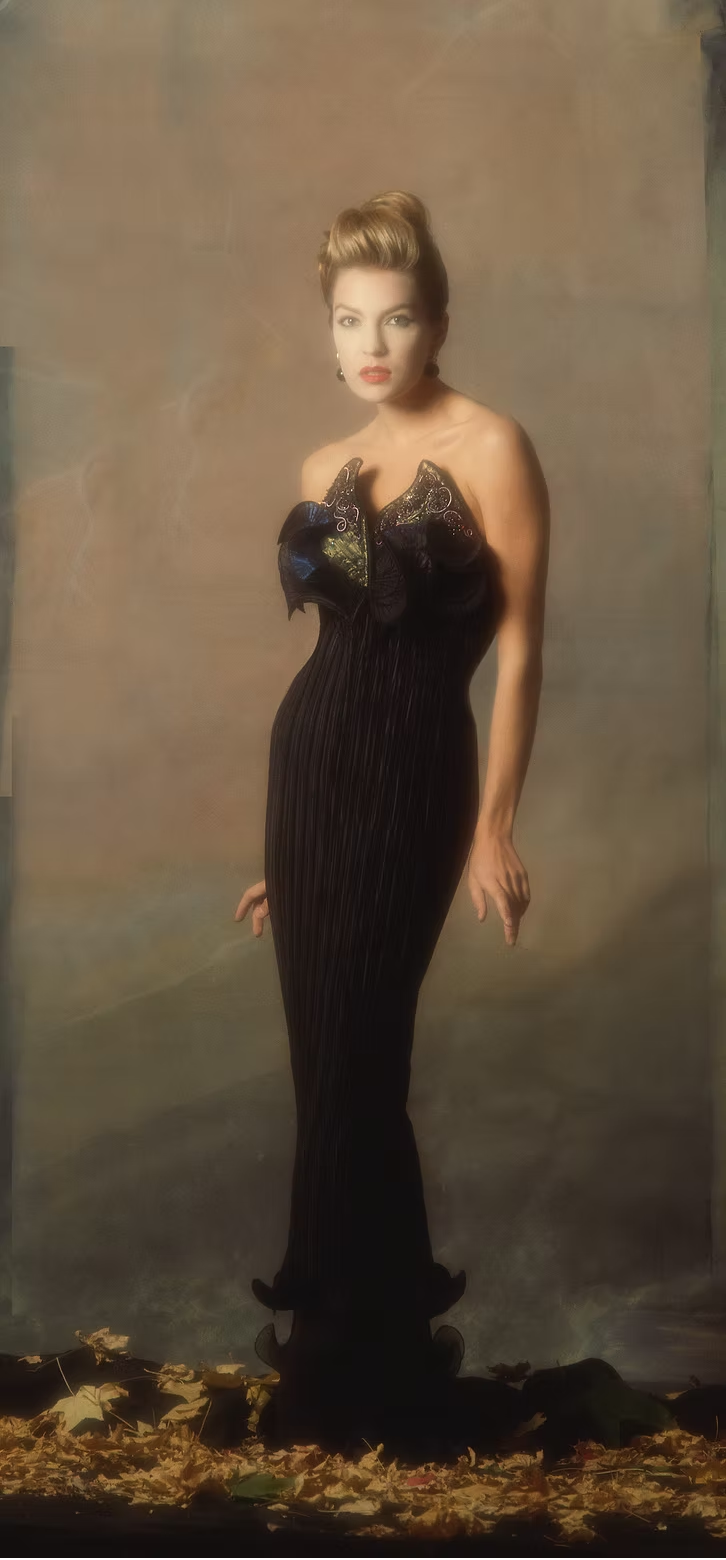
The Mermaid Gown shown on the right is in the permanent collection of the L.A. County Museum of Art.
It was during his time selling to Maxfield in Los Angeles that King custom designed many pieces for Elton John. Notable were the hats that appeared in music videos for songs such as “Sacrifice” (to view, click here) , and “You Gotta Love Someone” (to view, click here), as well as the red hat used in the Diet Coke commercial “Nightclub”. (to view, click here)
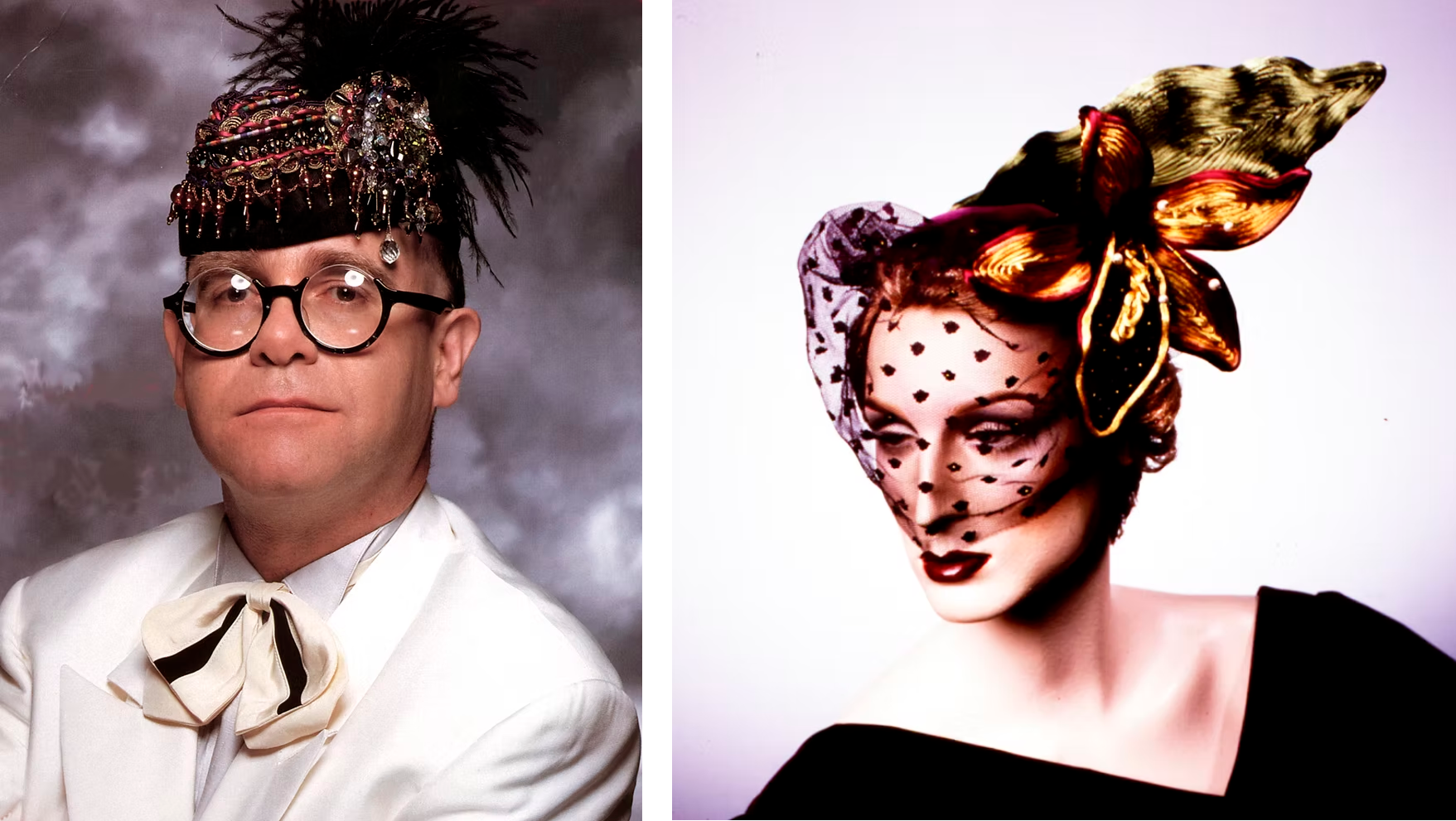
King began his business in 1985, in San Francisco. His hats were the first of his line of opulent, limited edition and one-off evening accessories and clothing.
To enhance the jewel-like nature of his pieces, he presented the designs in black velvet cases lined with black taffeta. Kenneth fully understood the importance of packaging and designed these cases to spotlight their allure. As these accessories were jewels, he felt it important to package them accordingly. This created an aura around the pieces that increased their allure. After the first cocktail hats came matching hats and muffs, followed by fur boas with concealed pockets for compact and lipstick worked into the embellishment. Kenneth’s exquisitely crafted vests and accessories found an avid clientele. The customers responded enthusiastically to his work, and began requesting other types of pieces.
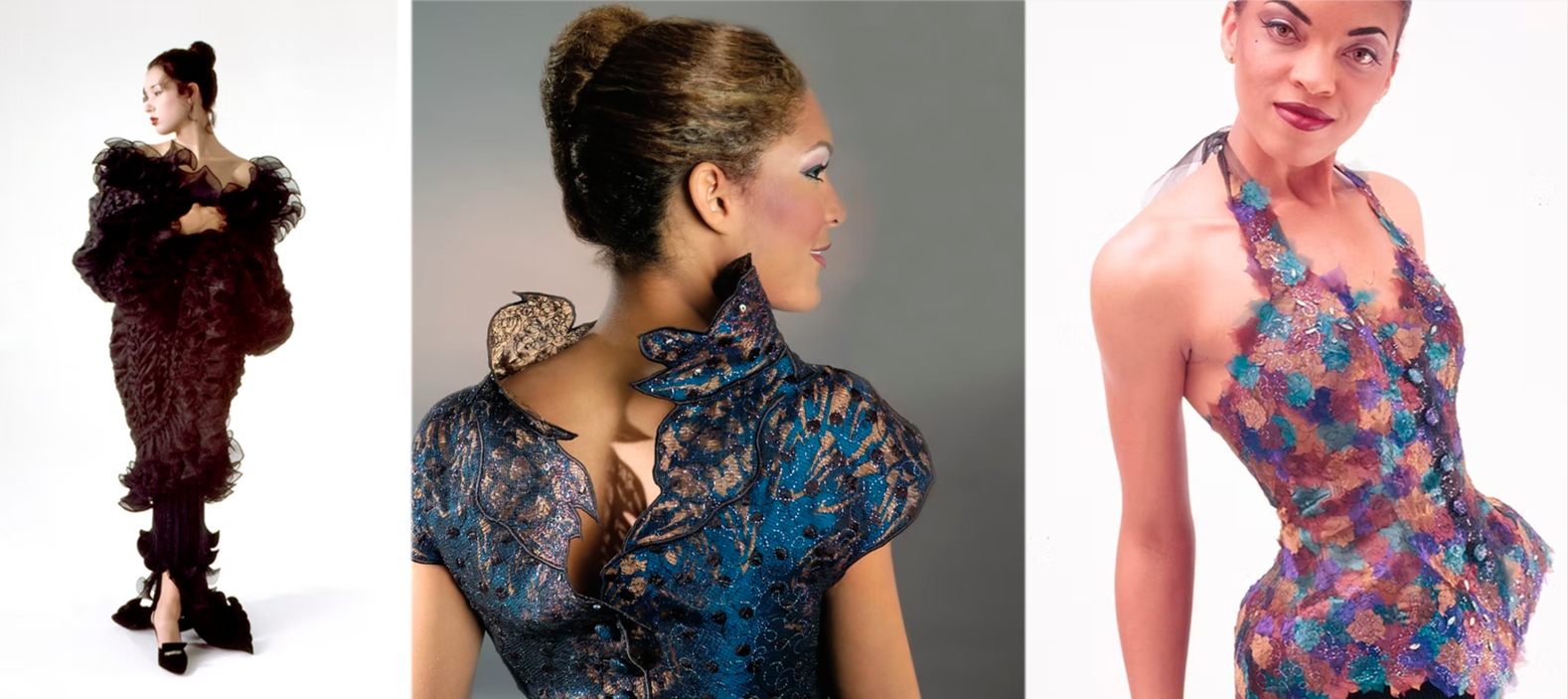
King’s work is in the permanent collections of museums such as the Victoria and Albert Museum in London. He strives to stretch his couture craft in new and more intriguing directions. King’s current body of work began with a reexamination of how clothing seams together in construction. These three “lines of inquiry” as he calls them are soufflé, leafing, and cutwork. To see a video on King’s work, click here.
Soufflé, inspired by origami folding techniques, is a combination of various fabric manipulation techniques. Read more here…
Leafing is a method by which King creates “a fabric in the shape of a garment”. Read more here.
Cutwork is the mirror-image process to leafing. Read more here.
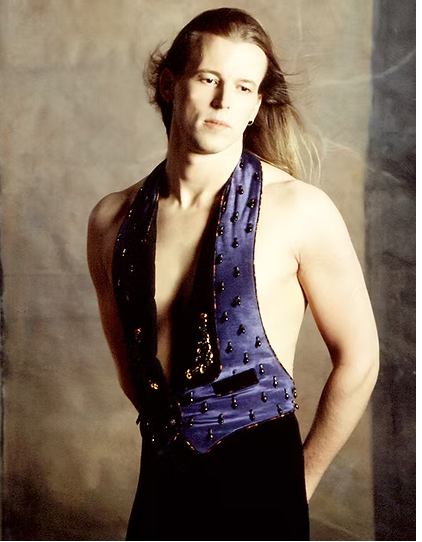
One of his early hits in 1986 was the Vest.
These vests featured sterling silver knot-buttons and matching sterling silver hardware of his own design, and were packaged in the signature black velvet boxes.
Vest collectors then demanded garments, which resulted in the Dinner Jacket. This jacket featured the same distinctive lapel shape and sterling button. A cumberbund, based on the vest, was also introduced at this time.
In 1986 King began selling his creations to Maxfield in Los Angeles, where the store’s Hollywood clientele discovered him. He was taken up first by Cloris Leachman; Elton John was also an early collector. Later such people as the Don Johnson and Geena Davis also became collectors.
Along with his other accessories, King created jewelry. In 1988, he introduced his “Marble Jewelry” – necklaces and bracelets of clear glass marbles encircled with sterling silver. These designs, both in sterling and later in 18-Karat gold, continue as popular day-into-evening accessories in King’s design repertoire.
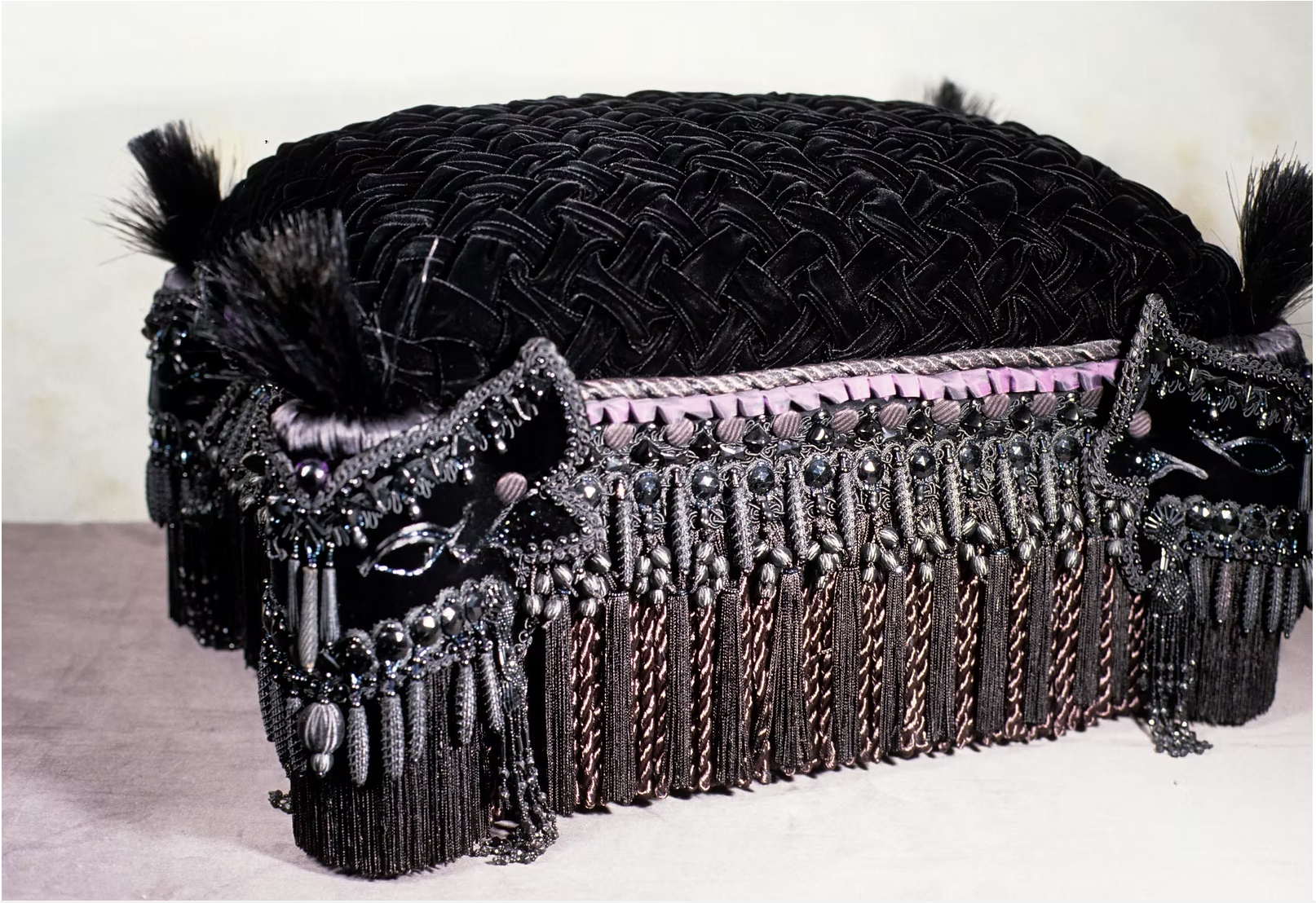
His furniture creations which started in the 1990’s meld plush Victorian form with intricate trim and lush, vivid colors. These highly worked “epic pieces” are created as artistic statements with little mind for their commercial value. His “Footstool” appears in the book “Elton John’s Flower Fantasies”, by Carol Cass (Bulfinch Press, p.53)